 TutorialKart.com
A square is a two-dimensional geometric shape with four equal sides and four right angles. It is a special type of quadrilateral, rectangle, rhombus, and parallelogram.
This tutorial explains the parts and properties of a square, how to construct a square, and how to calculate its perimeter, area, and diagonal.
Square Definition and Basic Structure
A square is a closed polygon formed by four line segments of equal length. Each pair of adjacent sides meets at a right angle of 90 degrees.
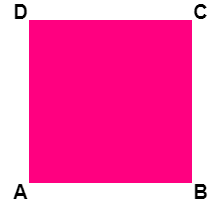
Following is a picture of a square.

To describe the square more precisely, let us name its vertices A, B, C, and D in order.
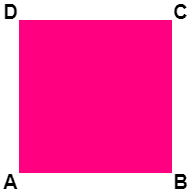
Like every quadrilateral, square ABCD has four vertices, four sides, four interior angles, and two diagonals.
| Part of square ABCD | Names | Relationship |
|---|---|---|
| Vertices | A, B, C, D | Four corner points |
| Sides | AB, BC, CD, DA | AB = BC = CD = DA |
| Angles | ∠A, ∠B, ∠C, ∠D | ∠A = ∠B = ∠C = ∠D = 90° |
| Diagonals | AC, BD | AC = BD |
Properties of a Square
The defining properties of a square involve its side lengths, angles, parallel sides, and diagonals.
All Four Sides of a Square Are Equal
All sides of a square have the same length. If one side has length a units, each of the remaining sides also has length a units.
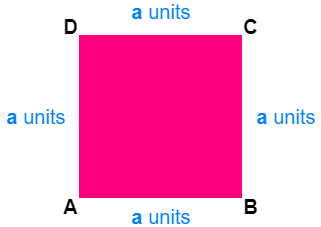
For square ABCD:
AB = BC = CD = DA
Every Interior Angle of a Square Is 90 Degrees
Each interior angle of a square is a right angle. Because a square has four right angles, the sum of its interior angles is 360 degrees.
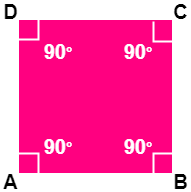
For square ABCD:
∠A = ∠B = ∠C = ∠D = 90°
Opposite Sides of a Square Are Parallel
The top and bottom sides of a square are parallel, and the left and right sides are parallel. Parallel sides remain the same distance apart and never meet when extended.
For square ABCD:
- AB is parallel to CD.
- BC is parallel to DA.
Diagonals of a Square Are Equal
A diagonal is a line segment joining two opposite vertices. A square has two diagonals, and they are equal in length.
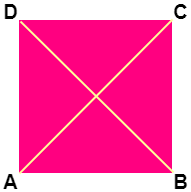
For square ABCD:
AC = BD
Each diagonal divides the square into two congruent right triangles.
Diagonals of a Square Bisect Each Other at Right Angles
If diagonals AC and BD meet at point O, each diagonal divides the other into two equal parts.
- AO = OC
- BO = OD
- AC is perpendicular to BD
The diagonals therefore intersect at an angle of 90 degrees. Each diagonal also bisects the two opposite angles through which it passes.
How to Draw a Square with a Given Side Length
A square is completely determined when the length of one side is known. The following construction draws a square with side length 4 cm using a ruler and a tool for constructing perpendicular lines.
Step 1: Draw the First 4 cm Side
Draw a line segment AB of length 4 cm.

Step 2: Construct a Perpendicular Side at B
At point B, draw line segment BC perpendicular to AB. Make BC exactly 4 cm long.
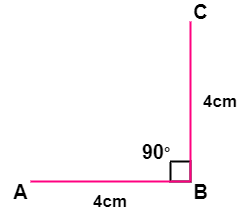
Step 3: Draw the Third Equal Side
From point C, draw line segment CD of length 4 cm. Make CD perpendicular to BC and parallel to AB.
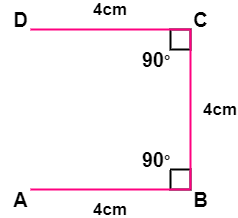
Step 4: Join D to A
Join points D and A with a line segment. If the preceding sides and right angles were constructed correctly, DA will also measure 4 cm.
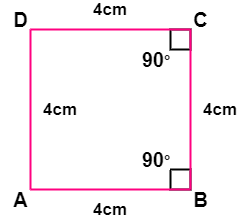
The closed region bounded by AB, BC, CD, and DA is square ABCD with a side length of 4 cm.
Perimeter of a Square
The perimeter of a square is the total length of its four sides. Since all four sides are equal, multiply one side length by 4.
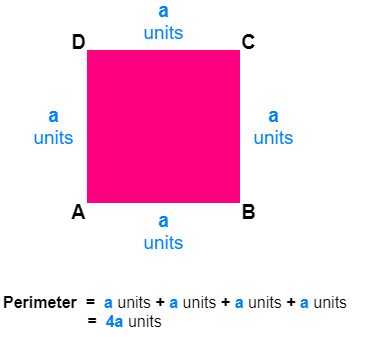
Perimeter of a square = 4 × side
If the side length is represented by a, then:
P = 4a
Square Perimeter Example
For a square with side length 4 cm:
- Use the formula P = 4a.
- Substitute a = 4 cm.
- P = 4 × 4 cm = 16 cm.
The perimeter of the square is 16 cm.
Area of a Square
The area of a square measures the region enclosed by its four sides. It is found by multiplying the side length by itself.
Area of a square = side × side
If the side length is represented by a, then:
A = a2
In the following diagram, the square has a side length of 4 units. Its area is the number of unit squares that fit inside it.
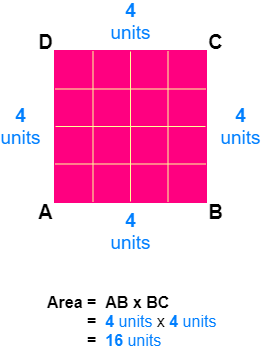
Square Area Example
For a square with side length 4 cm:
- Use the formula A = a2.
- Substitute a = 4 cm.
- A = 4 cm × 4 cm = 16 cm2.
The area of the square is 16 cm2.
Diagonal of a Square
A diagonal of a square forms the hypotenuse of a right triangle whose two shorter sides are sides of the square. Using the Pythagorean theorem, the diagonal can be calculated from the side length.
Diagonal of a square = side × √2
If the side length is a and the diagonal is d, then:
d = a√2
Square Diagonal Example
For a square with side length 4 cm:
d = 4√2 cm
Using √2 ≈ 1.414, the diagonal is approximately 5.66 cm.
Square Formula Table
| Measurement | Formula | Meaning of symbols |
|---|---|---|
| Perimeter | P = 4a | a is the side length |
| Area | A = a2 | a is the side length |
| Diagonal | d = a√2 | d is the diagonal length |
| Side from perimeter | a = P ÷ 4 | P is the perimeter |
| Side from area | a = √A | A is the area |
How a Square Relates to Other Quadrilaterals
A square satisfies the definitions of several other quadrilaterals because it combines equal sides, right angles, and parallel opposite sides.
- Rectangle: A square is a rectangle because it has four right angles.
- Rhombus: A square is a rhombus because all four sides are equal.
- Parallelogram: A square is a parallelogram because both pairs of opposite sides are parallel.
- Quadrilateral: A square is a quadrilateral because it has four sides.
The reverse statements are not always true. For example, a rectangle does not have to have four equal sides, and a rhombus does not have to have four right angles.
Frequently Asked Questions About Squares
How many sides and vertices does a square have?
A square has four equal sides and four vertices. Each vertex forms a 90-degree interior angle.
Are the diagonals of a square equal and perpendicular?
Yes. The two diagonals of a square are equal in length, bisect each other, and meet at right angles.
Is every square a rectangle?
Yes. A rectangle is a quadrilateral with four right angles, and every square has four right angles. However, not every rectangle is a square because a rectangle may have unequal adjacent sides.
What is the difference between the area and perimeter of a square?
Perimeter measures the total distance around the square and is expressed in linear units. Area measures the region inside the square and is expressed in square units.
How can the side of a square be found from its area?
Take the square root of the area. If the area is A, the side length is √A.